
The Co-Intelligent Workforce Report · 2026 Baseline
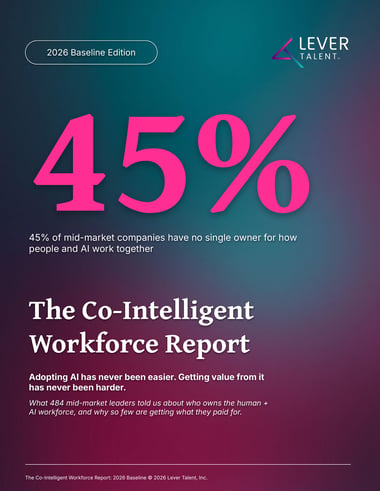
Adopting AI has never been easier. Getting value from it has never been harder.
What 484 mid-market leaders told us about who owns the human + AI workforce, and why so few are getting what they paid for.
484 Director-and-above leaders · US and Canada · 100 to 999 employees · Fielded August to September 2026
The spending is universal. The payoff is not.
97%
of mid-market companies have adopted at least one type of AI tool
92%
will spend more on AI next year than they did this year
28%
say AI is extremely valuable to their business today
45%
of mid-market companies have no single owner for how people and AI work together.
The lead finding
When it is everyone's job, it is no one's job.
Only 21% of companies have someone whose primary job is managing how people and AI work together. Everywhere else, decisions about which tools to buy, which workflows to automate, and who checks the AI's work are being made locally, inconsistently, and without anyone accountable for the whole.
53%
of leaders where no one owns the mix are not confident how work should be divided between people and AI
7%
feel the same way at companies where someone is accountable
Executive summary
Five findings. One pattern.
Every mid-market company has bought AI. What separates the companies getting real value is two decisions: who owns how people and AI work together, and whether that relationship was designed on purpose.
01 · Nobody Owns the Mix
45%
have no single owner for how people and AI work together. Only 21% have someone whose main job it is.
02 · The Adoption Illusion
28%
call AI extremely valuable, even though 97% have adopted it and 92% are still raising spend.
03 · The Orchestrator's Dividend
2.5x
Companies with a primary owner of the human-AI mix are 2.5x as likely to call AI extremely valuable, and 5.5x as likely as companies where no one owns it.
04 · The Tech-Only Dead End
8.3x
Technology-only adopters reach extreme value 6% of the time. Companies investing across technology, programs, and people get there 50% of the time.
05 · Design Decides
5.7x
Where the division of labor between people and AI is clear, and someone owns catching AI's errors, companies are 5.7x as likely to report extreme value.
See the data behind all five, and what the companies on the right side of each number did differently.
Download the full report
Get the 2026 Baseline Edition.
Five chapters, the charts behind every finding, and reactions from 16 economists, academics, and HR leaders.
- The Adoption Illusion: why 97% adoption has produced so little top-box value
- The Co-Intelligence Gap: where work breaks between people and AI, and why HR holds the seat less than one time in ten
- The Orchestrator's Dividend: the habits and investment mix of the companies pulling ahead
- What to do now: a step-by-step action plan for the CEO and the head of HR
Voices on the data
16 leaders reacted to the findings.
"AI compute is raw material. Turning it into valuable output requires intentional structure."
Chief Economist, LinkedIn
"You can give everyone a race car, but that doesn't mean everyone is going to be a great race car driver."
Chief Innovation Officer, Energage
"If organizations want AI to create real business value, HR needs to be in the room early."
CEO, Unbridled Talent; Chief Excitement Officer, DisruptHR
Also featuring John Baldino, Steve Browne, Theresa Fesinstine, Bart Houlahan, Cory Hymel, Nahed Khairallah, Jason Lauritsen, Carol Meyers, Lance Neuhauser, Michelle Strasburger, Bledi Taska, Sophie Wade, and Chris Worley.
The question for your next leadership meeting
Who, by name, owns how our people and our AI work together?
About this research: Lever Talent surveyed 484 Director-and-above leaders at US and Canadian companies with 100 to 999 employees, fielded August 17 to September 14, 2026. Research strategy by Port Research; survey design, fielding, and initial analysis by Researchscape. Findings are associations, not proof of cause. Full methodology is in the report.